If you have ever watched a strain reading drift after six hours of testing, or spent an afternoon chasing electrical noise through a bridge box, you already understand why fiber Bragg grating sensing found a home in structural and industrial measurement. At the center of that world sits one instrument: the fiber Bragg grating interrogator. It reads the light coming back from the gratings and turns it into numbers you can defend in a report.
Below we walk through what an interrogator actually measures, the main ways manufacturers implement that measurement, the specifications that decide whether a unit will work in your test, and how the optical front end fits together with the data acquisition, sensing and calibration equipment that finishes the job. Most of what follows comes from years of building measurement chains in vibration, strain and modal testing, and from the questions customers bring us while they are specifying a system.
What a Fiber Bragg Grating Interrogator Actually Measures
A fiber Bragg grating is a short length of optical fiber whose core refractive index has been written in a periodic pattern. That pattern reflects one narrow band of wavelengths back toward the source, and the center of that band, the Bragg wavelength, is set by the grating period and the effective refractive index of the guided mode. Stretch or compress the fiber and the period changes. Warm it up or cool it down and the effective index changes. Both effects shift the reflected peak, and across a wide working range that shift is very nearly linear.
The interrogator's job is to track that shift. It launches light into the fiber, collects the small fraction reflected by the gratings, and continuously determines the center wavelength of each reflection peak. The result is a wavelength-versus-time record for every sensor on the line, which becomes strain, temperature, pressure, displacement or acceleration once the appropriate sensitivity coefficient is applied. At 1550 nm a typical grating moves about 1.2 pm per microstrain and roughly 10 pm per degree Celsius, which is why resolution figures are quoted in picometers and sometimes in fractions of a picometer.
A rule of thumb worth remembering: at 1550 nm, 1 pm of wavelength resolution corresponds to roughly 0.8 microstrain of strain resolution. If an application genuinely needs to resolve 1 microstrain, the system needs picometer-class stability, not just a picometer-class resolution number on a datasheet.
It also helps to be clear about what these instruments are not. An interrogator measures wavelength, not returned optical power. That single design decision explains most of the technology's practical advantages: connector loss, long cable runs, source aging and bend losses all change how much light comes back, and none of them change the wavelength. It is also why FBG chains work happily next to high-voltage equipment, inside transformers, along pipelines and on wind turbine blades, where a long copper run would behave like an antenna.
Five Common Interrogation Approaches, Compared
There is more than one way to find a peak in a spectrum, and the method a designer chooses shapes almost everything else about the instrument: its speed, its channel count, its physical size and its cost. These are the approaches you will meet most often.
Common fiber Bragg grating interrogation methods and the applications each one tends to suit.
| Approach |
How it works |
Typically strong at |
Main trade-off |
| Tunable filter plus photodiode |
Sweeps a narrow passband across the spectrum and logs returned power |
Multi-sensor arrays, rack-based monitoring |
Scan speed limits fast dynamic events |
| AWG chip plus detector array |
Passively separates wavelengths onto parallel detectors |
Compact, low-power, embedded systems |
Fixed channel grid, limited tuning |
| Spectrometer with detector array |
Disperses the full spectrum and reads all wavelengths at once |
High-speed parallel acquisition |
Lower wavelength resolution, fewer channels |
| Swept tunable laser |
Illuminates one wavelength at a time and tracks the peak precisely |
High accuracy, wide range, static and quasi-static work |
Cost and finite scan rate |
| Edge filter, ratiometric |
Converts a wavelength shift into an intensity ratio |
Fast single-point dynamic strain |
Narrow dynamic range, few gratings |
In practice the decision usually narrows to two questions. How many gratings must be read at the same time, and how fast do they move? Logging a temperature once a minute and capturing a millisecond transient are very different problems, and an interrogator that excels at one is rarely optimal for the other.
Specifications That Decide Whether a Unit Works in Your Test
Datasheets tend to list the same dozen parameters. What matters is which ones bind your application. These are the points we go through with customers before a system is signed off:
- Wavelength range and channel count. A 40 nm span and a 100 nm span cover very different numbers of gratings, especially when some are pre-strained to separate their peaks.
- Resolution versus accuracy. Resolution is the smallest change the instrument can see. Accuracy is how close the absolute reading is to the true wavelength. Long-term stability and repeatability usually matter more than either.
- Absolute or relative measurement. Some work only needs change over time; other work, such as temperature compensation or shape sensing, needs a trustworthy absolute reference.
- Sample or scan rate. Static monitoring, fatigue cycling and impact events sit three orders of magnitude apart. Match the instrument to the fastest phenomenon you must capture, not the average.
- Multiplexing capacity per channel. This determines how many sensors a single fiber can carry, and therefore how much cabling and how many connectors your installation needs.
- Dynamic range and crosstalk. When a strongly loaded grating sits next to a lightly loaded one on the same fiber, weak peaks should not be pulled around by strong neighbours.
- Optical budget and connectors. Single-mode fiber type, coating, FC/APC terminations and splice quality all consume budget before the signal ever reaches the detector.
- Environmental rating. A laboratory unit in a rack and a field unit on a bridge deck have different requirements for temperature range, vibration tolerance and ingress protection.
- Software, interfaces and synchronization. Trigger inputs, shared clocks, streaming APIs and export formats decide how easily the interrogator joins the rest of your measurement system.
- Calibration and traceability. Wavelength references drift. Ask how the instrument is verified, how often, and what documentation comes with it.
How Much Speed Does Your Application Really Need?
The chart below is an illustration of relative demand rather than a specification, but it captures the spread that shapes every purchasing decision in this field.
Static temperature trending
Long-term strain monitoring
Fatigue and cyclic loading
Modal and impact testing
Transient dynamic strain
The lesson is simple: buy speed where you need it and stability everywhere else. A slower, quieter instrument with a good wavelength reference often outperforms a faster one in long-duration monitoring, where drift over weeks is the real enemy.
Where Fiber Bragg Grating Sensing Earns Its Keep
The technology is chosen when conventional electrical sensing runs into a wall. Some patterns we see again and again:
- Structural health monitoring. Bridges, dams, tunnels, piles and pipeline supports, where dozens of strain and temperature points share one fiber and one interrogator.
- Energy and power. Transformer windings, generator stators, high-voltage environments and turbine blades, where electromagnetic immunity removes a whole class of noise problems.
- Aerospace and composites. Gratings embedded directly into laminates during manufacture, surviving where surface-bonded gauges would not.
- Rail and transportation. Long-term monitoring of rails, sleepers and vehicle structures exposed to weather, vibration and electrical interference.
- Industrial machinery and process plant. Hot, wet or chemically aggressive locations where a passive glass sensor outlasts a foil gauge and its lead wires.
One practical caveat is worth stating plainly: a bare grating responds to strain and temperature at the same time. Unless the application separates the two, by pairing a strain-free reference grating with each measuring grating or by characterising the thermal response, the interrogator will faithfully report a number that mixes both effects.
The Rest of the Chain: From Wavelength Data to a Finished Measurement
An interrogator rarely works alone. Its wavelength record still has to be synchronized with everything else in the test, acceleration, force, pressure, displacement and rotational speed, and then analysed. That is the part of the chain we spend our working days on at Yangzhou Zhenzhong Testing Technology.
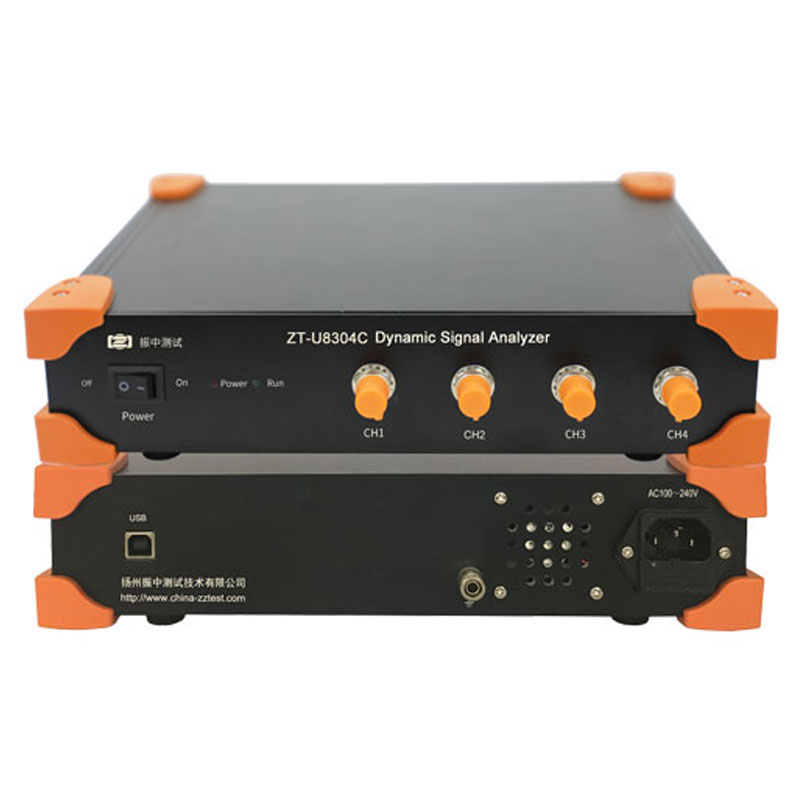
On the electrical side, a dynamic signal analyzer handles simultaneous sampling across many channels, with the input conditioning that different sensors need. Our USB, 100 Mbps network and gigabit network instruments cover single-channel portable work up to 32-channel synchronous acquisition, which is what a large structure or a multi-point modal survey usually demands. If you would like a clearer picture of where such a box sits relative to a conventional instrument, our note on how a dynamic signal analyzer differs from a traditional instrument is a good starting point.
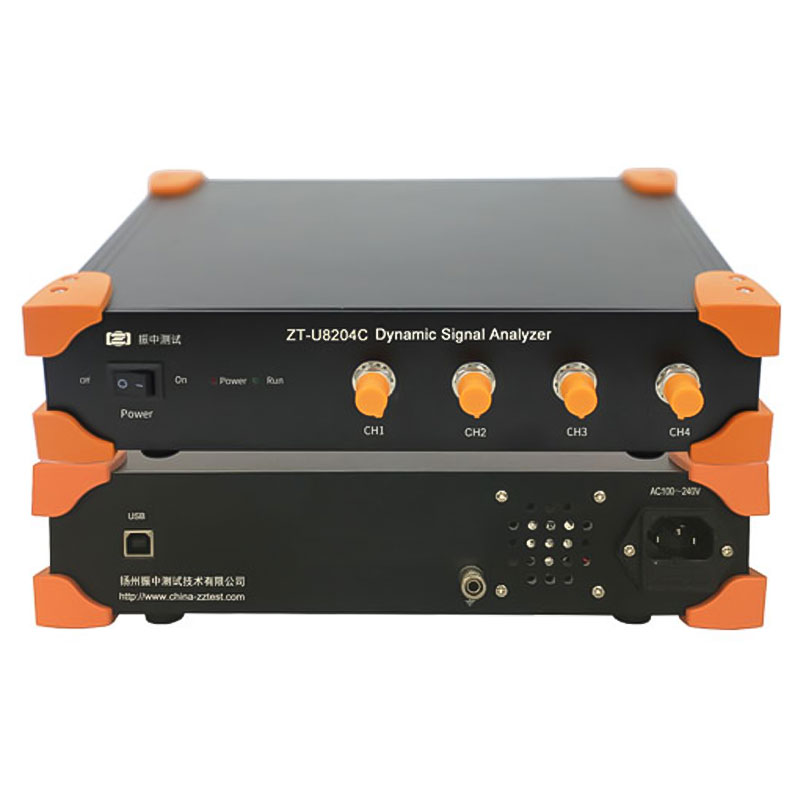 ZT-U8204C Four-Channel Dynamic Signal AnalyzerIts four channels, 24-bit conversion and voltage/IEPE/charge inputs suit modal, machinery fault, noise and transient measurements with direct sensor connection.View Product →
The sensing layer matters just as much, because a clean optical reading paired with a noisy accelerometer still produces a questionable result. Charge and IEPE accelerometers, micro triaxial units, force and pressure transducers, and acoustic microphones are chosen to match the frequency range and amplitude of the phenomenon under test, not the other way round.
 IEPE Accelerometer Category from Yangzhou Zhenzhong TestingThis category introduces Zhenzhong Testing's IEPE accelerometer range alongside charge and micro triaxial accelerometer listings, though no individual models are currently shown.View Product →
Finally, there is calibration. A measurement chain is only as good as the reference at the end of it, and that is true of optical and electrical channels alike. Field-verifiable sensor and channel checks keep numbers comparable between campaigns, between laboratories and between years.
Portable Vibration Calibrator Category from Zhenzhong TestingThis category highlights Zhenzhong Testing's portable vibration calibrator offerings, listing five products for users checking measurement-chain references, though individual models and specifications are not shown.View Product →
When these pieces are designed together rather than assembled one purchase at a time, the integration work drops sharply. That is the reasoning behind our vibration and dynamic testing solutions, which combine excitation, sensing, acquisition, analysis software and service into a single accountable system.
A Practical Selection Checklist
- Write down the physical quantities you must measure, their expected ranges, and the fastest change you must resolve.
- Count the sensing points and decide how they will be distributed across fibers and channels.
- Choose the interrogation method that fits that count and that speed, then confirm the optical budget for your cable lengths.
- Check how the instrument will be synchronized with your other channels, whether by trigger, shared clock or timestamped streaming.
- Ask for a stability specification over hours or days, not only a resolution figure at one moment in time.
- Confirm the calibration and verification path, including who performs it and what certificate you receive.
- Test the software with your own data before committing, particularly the export and analysis workflow your team will live in.
Questions We Hear Most Often
Can one interrogator handle strain and temperature at the same time?
Yes, provided the installation is planned for it. A common approach is to place a strain-free grating near each measuring grating, so the temperature-only peak can be subtracted. Both types of grating sit on the same fiber and are read by the same instrument.
How many sensors can share one channel?
It depends on the wavelength range of the instrument and how far apart the peaks must be to remain separable. Gratings with different center wavelengths are distributed across the available spectrum, which is why range and multiplexing capacity are tied together so closely.
Do I still need conventional accelerometers if I already have FBG sensors?
Usually yes, for modal and vibration work. Optical strain sensing describes how a structure deforms, while accelerometers describe how it moves. Most serious test programmes record both and analyse them together, which is exactly why synchronization between the optical and electrical sides of the chain deserves attention early.
A fiber Bragg grating interrogator is an elegant instrument, but it is one link in a chain that begins with a sensor installation decision and ends with an analysed result someone has to sign. The projects that go smoothly are the ones where range, speed, channel count, cabling and calibration were all worked out before the purchase order.
If you are building that chain now and want a second opinion on the electrical side, our team is happy to talk through channel counts, input types, sampling rates and calibration practice. Send us your measurement plan and we will tell you honestly where an optical solution fits and where a conventional one will serve you better.

 English




















 Address : No. 85, Hetao West Road, Hanjiang District, Yangzhou City, Jiangsu Province, China
 Phone: +86-0514-85764839
 Tel: +86-0514-85764839
 Email: sales@china-zztest.com
